
PUBLICATIONS
Pavla Dundálková in conversation with Marek Meduna. Potyčka na území nikoho, Center for Contemporary Arts Prague.
She had to put her calling temporarily on hold. Bystanders felt she had shed her skin. It’s growing, expanding in all directions. What’s up is down. Shallowness was being transformed into vastness. She laid small souvenirs behind the elastic membrane of urgent duties. Washing, ironing, cooking, being a step ahead, minding her own business and smiling. The last above all. A ruffled, loosely flowing fabric stretched across the room. It divided the space in two. It was easy to cross, but far from visible. An endless, free-floating feed of rising standards from Instagram permeated the nearby space. Influencers mingled with the cooing of pigeons on the windowsill. She looked up at the window and saw only the passing of time. Everyone needs certain conditions to live. Things were different in Bertold Brecht’s time than today. Entitles and rights dug like thorns into her soft skin. She typed her name into Google. Over the years, information has been hierarchised in different ways, the algorithm has changed without this being visible in its instantiation. At first glance everything remained the same. She opened the box and walked deep into the forest. The path turned into a trail. The trail dissolved into dense undergrowth from which the rustling of hidden animals could be heard. She wanted to coax a few dryads, though she knew not why. She hadn’t even seen their silhouette yet. Brokilon was silent. She set up camp for the evening. She sat staring into the darkness of the chest. She chewed foxglove on her tired, aching body. When she awoke in the morning, they stood silently around her. Slender and blending into their trees. One by one they told her that the sight of soil, dirt, mud and cracked earth gave them the greatest pleasure. The soil has its suppleness, its colour, its texture and its latent shape. They feel a piece of the whole world in the palm of their hands. What excites them the most is the space inside, where the soil comes alive and the seed becomes the germ for photosynthesis and new life. So they feel included in its course. The parable of the cave is turned inside out. The stalactites and stalagmites were eating into the open space. Truth has divided itself into too many simultaneous and individually undemanding tasks. There are doors that have been closed until the end of the world. Marek Meduna
Potyčka na území nikoho, eds. Marek Meduna, Zuzana Blochová, published by Center for Contemporary Arts Prague, 2024
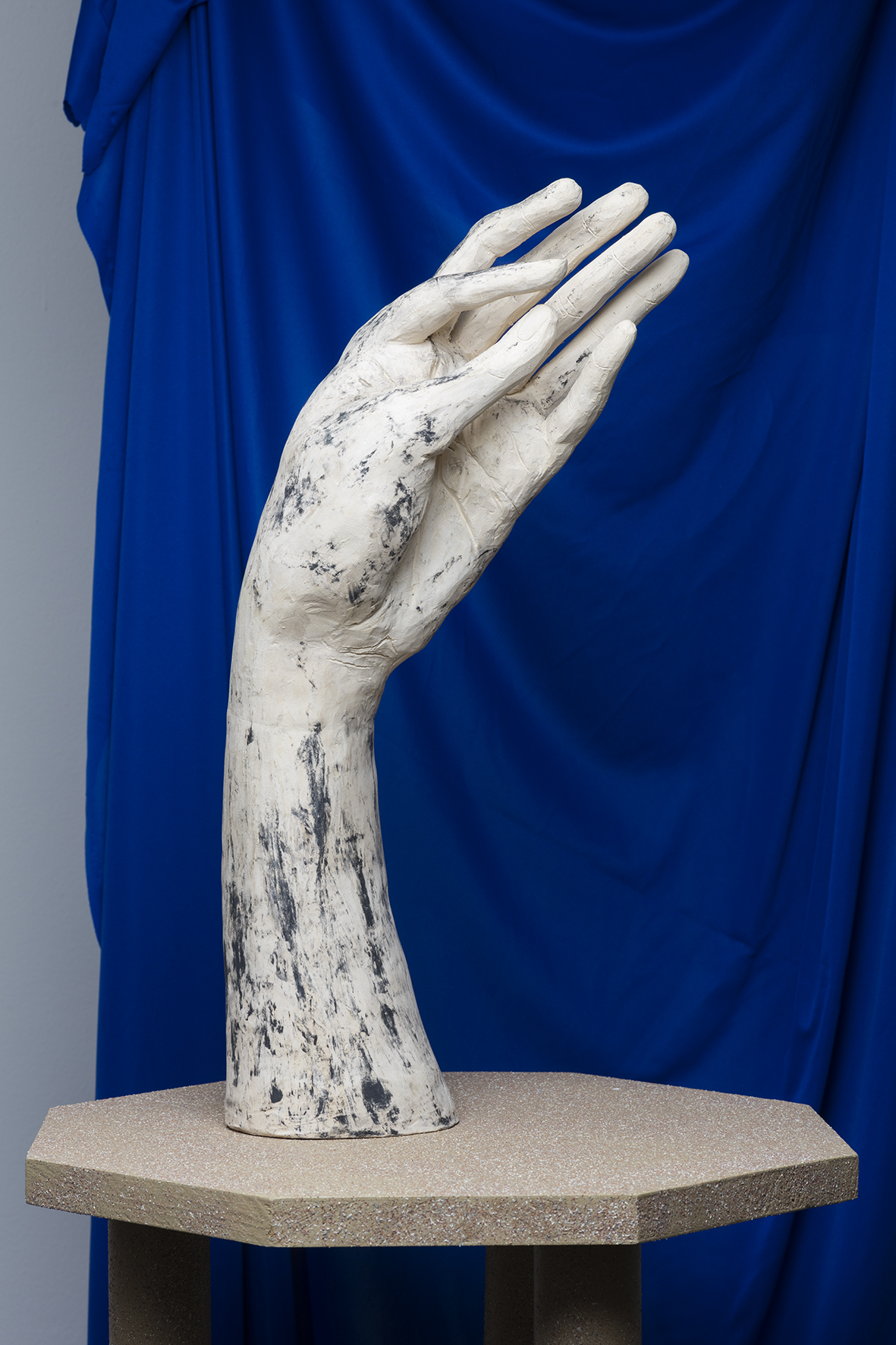
Image: Pavla Dundálková, Multitasking hand, 2021. Photo by Jiří Thýn. Courtesy Stone Projects.
COLLECT
Discover all available artworks on the platform and enquire about artists Argišt Alaverdyan, Pavla Dundálková, Richard Nikl, David Vojtuš
PUBLICATIONS
Richard Nikl in conversation with Marek Meduna. Potyčka na území nikoho, Center for Contemporary Arts Prague.
Once upon a time, in an exhausted era in which nothing could apparently happen. Every exhibition is a small battle in the heat of the culture war. Individual skirmishes both consolidate and undermine constellations of opinions. Their rhythm and harmony is the heartbeat of a warring community. The culture war is both portend and sublimation. It is easy to escape its roar. Opinions can be circumvented. The edges are rounded for user comfort. Excesses seep into online news bulletins, where they are quickly digested by the machinery of individualised feeds. Shapes are blurred, masses and colours are re-interpreted. The gaze penetrates even where it is not invited. Individually invented expressions (řasokoule, zooludie, ableism, mallogic, post-irony, wokerarti, herderizza) with indistinct meanings may be a symptom of our prolonged immaturity, dangerous exuberance or cultural schizophrenia.
In the polyrhythm of rhymes and consonants, more than one cultural heritage with its tendency to moralise has been dumped, like a lump at the foot of the simply boiled flavours of sauces and the thick stock of soups. Several warnings hang on the fence of the wild apple trees. Their compliance warns that the murky rivers of culture move towards dissolving in the sensation of an ocean. The brackish water slowly evaporates, leaving the cargo collected on its way down the continent and like a raincloud heads for revival in a clear mountain spring. It is not for nothing that the word Mohan (Main) is derived from the Indo-European mei or water and the word Alps from the Latin albus (white) or altus (high). The hedonistic response of contemporary art is articulated both in cycles and fractures. Marek Meduna (extract)
Potyčka na území nikoho, eds. Marek Meduna, Zuzana Blochová, published by Center for Contemporary Arts Prague, 2024
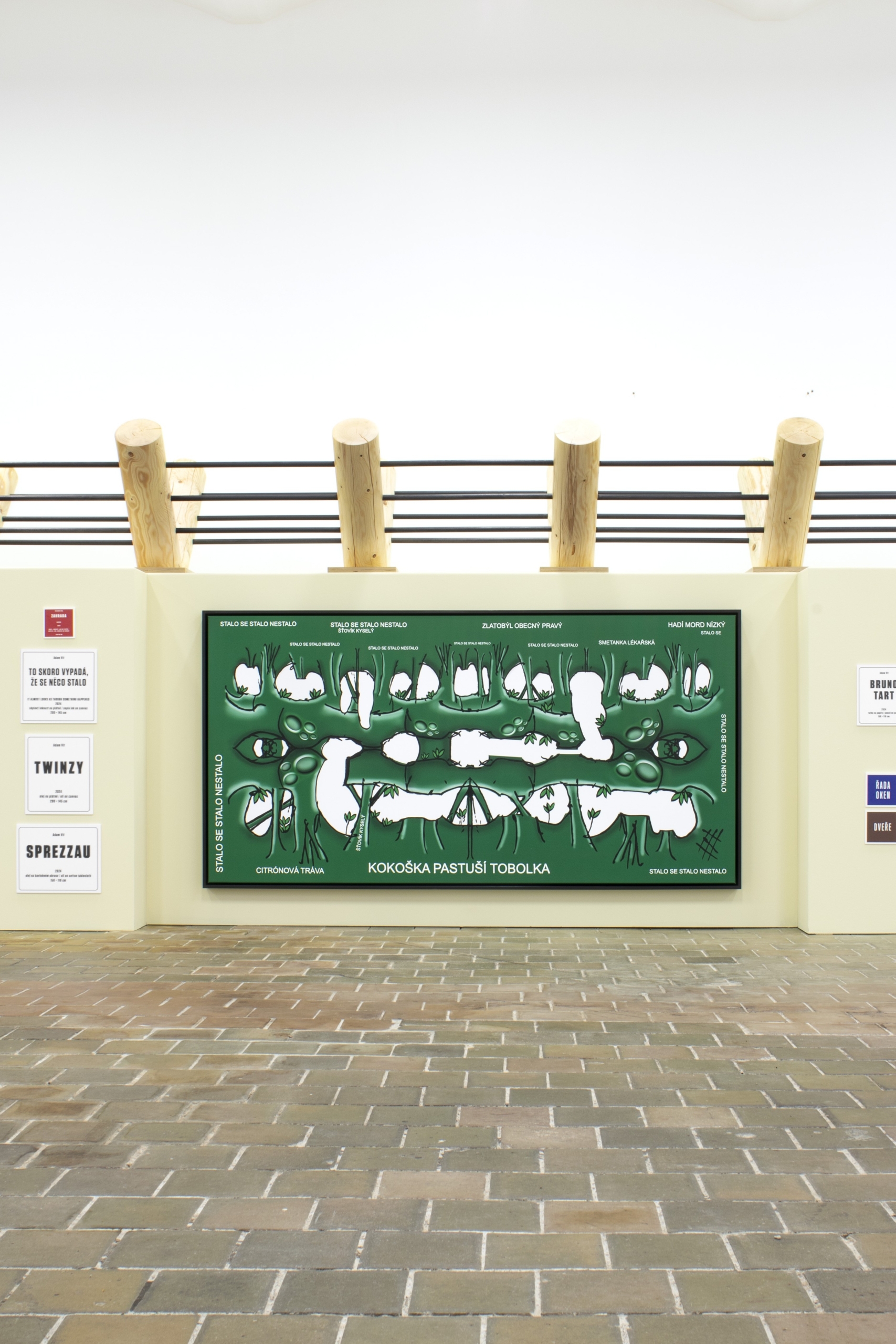
Image: Richard Nikl, Garden, 2024, 180 x 90 cm. Courtesy the artist.