NEWS
Argišt Alaverdyan, Phantomium at kulturák Archa in Lubná, CZ, Oct 4, 2026 – Apr 14, 2027
The name Phantomium derives from the English word phantom /ˈfæn.təm/, which can be used as both a noun and an adjective. It denotes a phenomenon, being or object that seems real even though it does not exist: a spectre or an apparition. Argišt Alaverdyan’s series Vibrations and Phantomium capture the tonality of temporary configurations of which only residual matter remains visible. This matter testifies to their former existence, which may be reality, or may be illusion.
Acrylic spray paint and white graphite create a haze of graduated shades of grey on the canvas, which in places turns into a flicker reminiscent of the grain of analogue screens. This is Vibrations, a series of thirty paintings in which waves, arcs, brackets and spirals emerge from a seeming blur or visualised noise. It is as if the signal that allows us to glimpse these small yet complex scenes for a brief moment were gradually fading before our eyes.
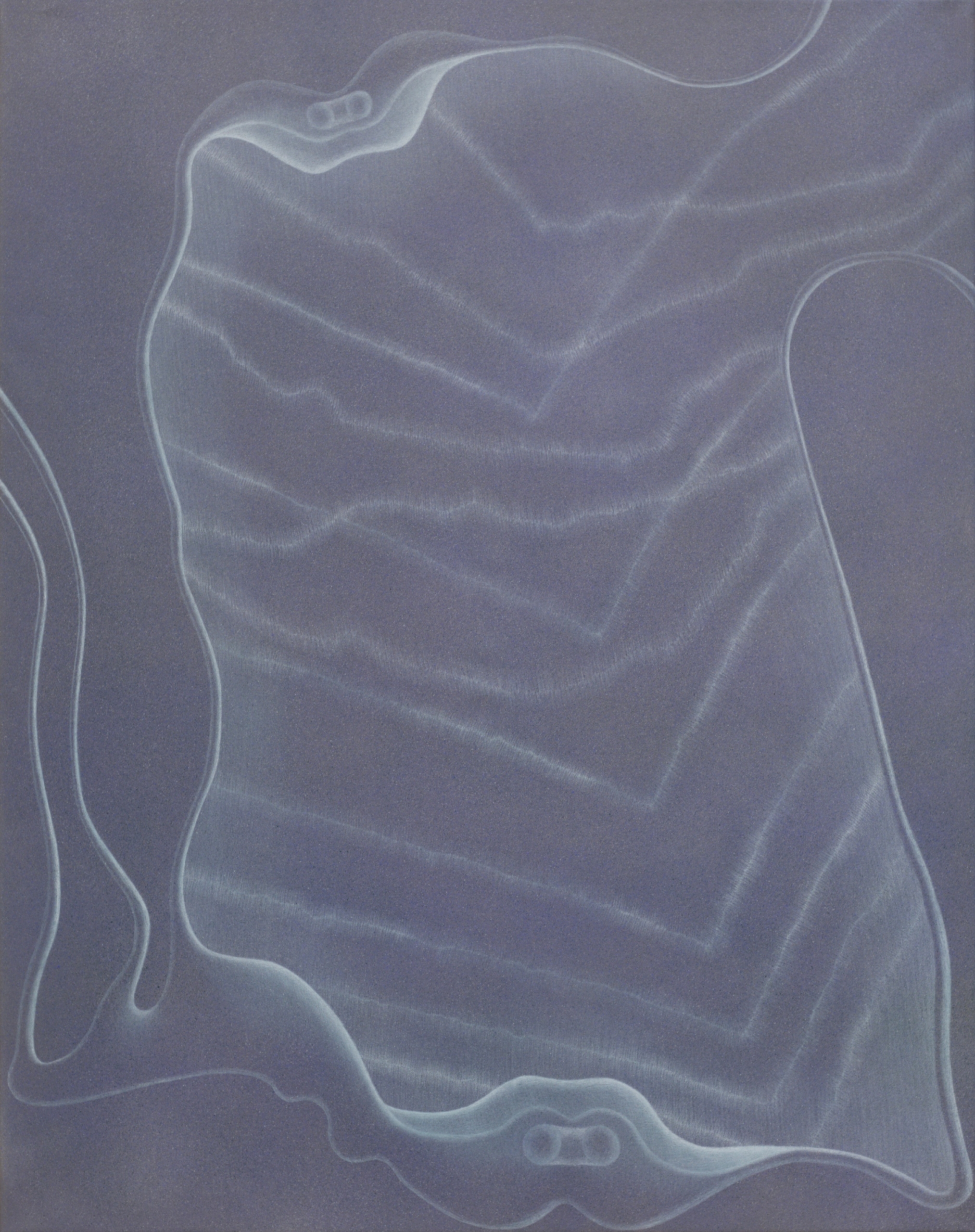
The trio of medium-format paintings belongs to the Phantomium series. Phantomium is a fictional element of a non-existent periodic table of phantoms, spectres and entities that may have evolved from virtual worlds, or may have been here with us all along. The three paintings take shape on a grainy surface in a violet tonality. The white drawings on these textures are spectral in their position between abstraction and the concrete, and recall misty vapours or wisps of steam.
They explore a certain lightness, in which the depicted phenomena drift through space, hover, and some even grin pleasantly at their beholder. They draw on the aesthetics of emoticons, blended with an almost Lovecraftian, sublime and primordial monstrosity and its iconography. The entities rising out of the noise carry something both contemporary and mysteriously ancient, and may awaken in us a strange nostalgia whose origin we cannot pin down.
Together, Vibrations and Phantomium point to the transience and urgency of a unique “here and now”, an unrepeatable moment shaped by forces beyond our control. In the gallery, they are complemented by site-specific wall drawings that echo the undulating motifs of the paintings. These lines then become the ground for the hanging paintings themselves. We become witnesses to moments of appearing and vanishing, of formation and deformation. Alaverdyan’s drawings are a kind of imaginative record: notional drawn photographs that capture, with scientific precision, moments in which a certain spectral matter is present. Lucie Formánková
Image: Argišt Alaverdyan, Phantomium, 2026, spray and white coal on canvas, 110 x 90 cm. Courtesy the artist.
PUBLICATIONS
Pavla Dundálková in conversation with Marek Meduna. Potyčka na území nikoho, Center for Contemporary Arts Prague.
She had to put her calling temporarily on hold. Bystanders felt she had shed her skin. It’s growing, expanding in all directions. What’s up is down. Shallowness was being transformed into vastness. She laid small souvenirs behind the elastic membrane of urgent duties. Washing, ironing, cooking, being a step ahead, minding her own business and smiling. The last above all. A ruffled, loosely flowing fabric stretched across the room. It divided the space in two. It was easy to cross, but far from visible. An endless, free-floating feed of rising standards from Instagram permeated the nearby space. Influencers mingled with the cooing of pigeons on the windowsill. She looked up at the window and saw only the passing of time. Everyone needs certain conditions to live. Things were different in Bertold Brecht’s time than today. Entitles and rights dug like thorns into her soft skin. She typed her name into Google. Over the years, information has been hierarchised in different ways, the algorithm has changed without this being visible in its instantiation. At first glance everything remained the same. She opened the box and walked deep into the forest. The path turned into a trail. The trail dissolved into dense undergrowth from which the rustling of hidden animals could be heard. She wanted to coax a few dryads, though she knew not why. She hadn’t even seen their silhouette yet. Brokilon was silent. She set up camp for the evening. She sat staring into the darkness of the chest. She chewed foxglove on her tired, aching body. When she awoke in the morning, they stood silently around her. Slender and blending into their trees. One by one they told her that the sight of soil, dirt, mud and cracked earth gave them the greatest pleasure. The soil has its suppleness, its colour, its texture and its latent shape. They feel a piece of the whole world in the palm of their hands. What excites them the most is the space inside, where the soil comes alive and the seed becomes the germ for photosynthesis and new life. So they feel included in its course. The parable of the cave is turned inside out. The stalactites and stalagmites were eating into the open space. Truth has divided itself into too many simultaneous and individually undemanding tasks. There are doors that have been closed until the end of the world. Marek Meduna
Potyčka na území nikoho, eds. Marek Meduna, Zuzana Blochová, published by Center for Contemporary Arts Prague, 2024
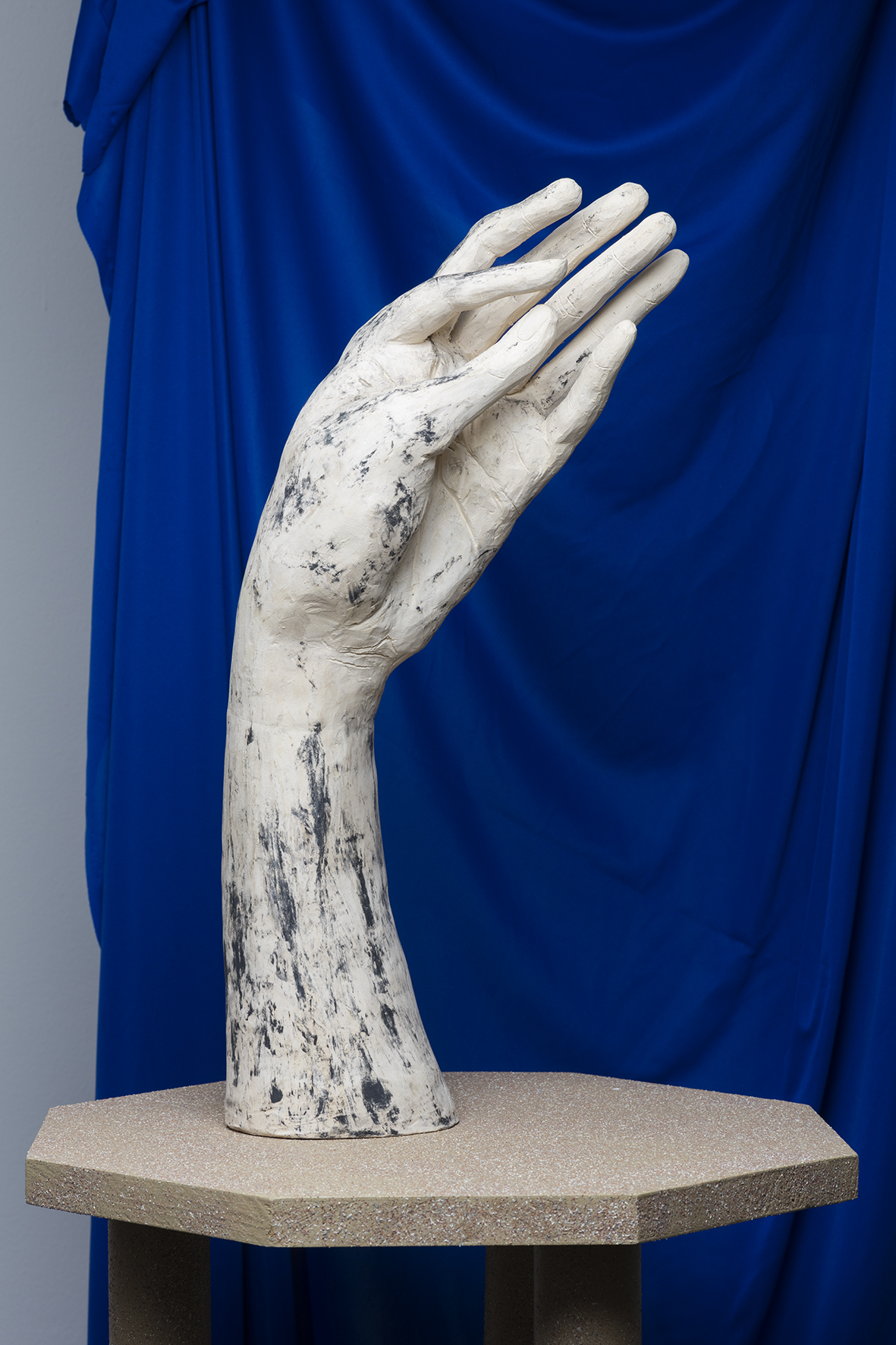
Image: Pavla Dundálková, Multitasking hand, 2021. Photo by Jiří Thýn. Courtesy Stone Projects.