

Dec 18, 2025 – Feb 20, 2026
Markéta Adamcová / Promiscuity
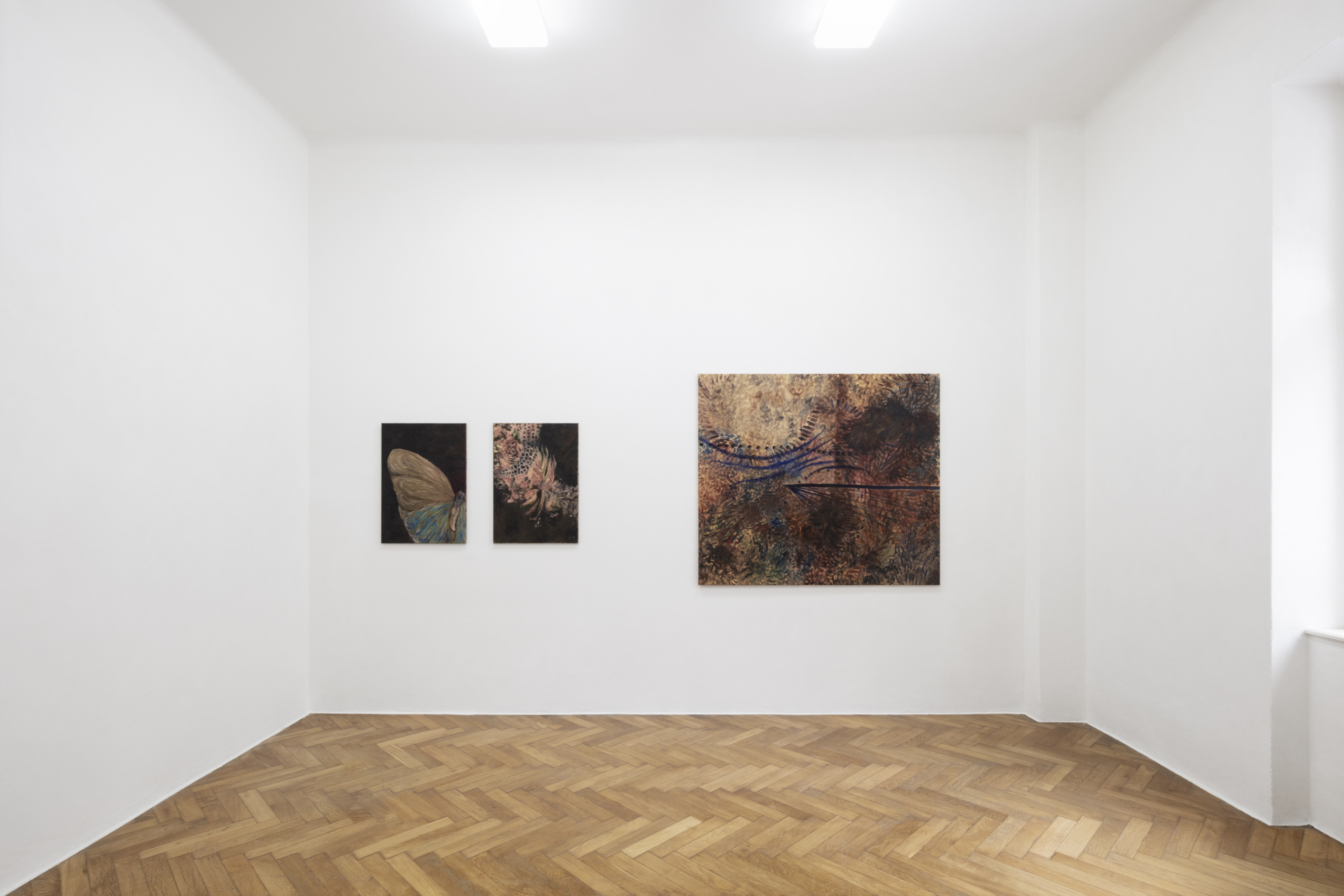
Markéta Adamcová’s oeuvre scrutinizes themes of nature, matter, and fertility, showcasing a visceral, painterly language in which insect and human bodies transmute in intricate crossovers of growth, decay, and rebirth.
In a recent series of works by Markéta Adamcová, the rhythm of brown, earthly tumbleweeds and seeds rotate and swirl. Recalling the transcience of bloom, it counters the mechanised predictability of daily life. Petals and carpels shiver; mating rituals entice bees in overflows of enzymes, promiscuous encounters in which the beauty of plants reveals nature’s mastery. Nature is beautiful—beautiful beyond comprehension. But, as Esther Leslie asks, what are the distinctions in creativity between nature and art? Is nature artistic, is she a real artist? Marks of the brush trace paths on cold surfaces and in layered dabbings; oil paint sinks into paper and the colours of soils deepen, replacing pinks and ochres. Something bulges and spills—words, rhymes—something asks to be buried.
For her new body of work at stone projects, Adamcová takes inspiration from seminal works of early twentieth-century Futurism—most notably the Rayist painting Glass (1912; Steklo) by Mikhail Larionov, studied by the artist at the Guggenheim during her residency in New York. In Sequence (1913) by Giacomo Balla, geometrical grids play at alienation—attempting to capture the light and speed of modernist city dreams. By examining Futurist references to the dynamics and rhythms of machine-made urban existence, Adamcová reformulates these as human-made infrastructures, with gestural interventions that operate both as materiality and as abstract systems of labour, time, and rest.
Skilfully blending loose, expressive swathes of colour with detailed renditions of moths, something is lost and gained—a contamination, and cross-pollination is everywhere, a nightmare that tumbles and stains. The overgrowth of invasive plants covers large swathes of land; poisonous jellies overpopulate seas in electric blue; rivers turn jade green in fertile swells. The infrastructures of conquest, business, and governance have made—and continue to make—the Anthropocene. Invisible micro-elements, molecules of CO₂ overproduction, turn landscapes red, as if painted by the heat of fuel-burning factories.
Introducing decay, a vulture draws closer. Dragging its hunger through the sky, it circles. Layers and featherings—nestings made of colourful plumes—spiral, then stop: the onset of autumn only mildly palpable. Toxin and pathogens flow in and out of bodies, settling in the soils of industrialised farmland. The act of cleansing is to purify, but as Bruno Latour argues, the more we purify, the more we hybridize. What escapes are electric shocks, medusas, trees without roots. A pairing of celestial beings—deep yellow and blue patterned moons—a red, placental swathe of paint hints at the satisfaction of arrival. Shells of sky and earth invite different kinds of hospitality: bodies that feast, a feast of one another.
Hana Janečková
Markéta Adamcová (b. 1992) studied at Städelschule – Staatliche Hochschule für Bildende Künste, Frankfurt am Main (2023–2025) and at the Academy of Fine Arts in Prague (2013–2019). Lives and works in Berlin and Prague. She has exhibited work at the Academy of Visual Arts – HKBU, Hong Kong (2025); Garage Gallery, Prague (2024); INI Gallery, Prague (2024) among others.
Press: Contemporary Art Library
Images: Markéta Adamcová, Promiscuity, 2025. Courtesy stone projects.
Prague, 15/05/2026
We are deeply concerned by the allegations raised by employees of the Museum of Contemporary Art in Kraków against Adam Budak.
We firmly reject these accusations. As his close collaborators during his five-year tenure at the National Gallery Prague, we never witnessed any conduct resembling the behaviour now being attributed to him. On the contrary, we came to know Adam Budak as a person guided by professional respect and open dialogue. His professional expertise and international reputation never prevented him from actively supporting his colleagues. His commitment to art, sensitivity, and exceptional dedication to work have remained a lasting source of inspiration for us.
During his tenure as Artistic Director, attendance at the National Gallery Prague increased significantly, nearly doubling to approximately three-quarters of a million visitors annually, while ticket revenue tripled. His personal standing also contributed substantially to the international visibility of Czech contemporary art. His dismissal, moreover without any reasons being provided, therefore caused considerable outrage not only within the Czech art scene.
At the time, the interim Director General had neither previously nor subsequently held a position of comparable significance. The justification later formulated under pressure from the Ministry of Culture of the Czech Republic lacked both factual and legal grounds and, in effect, would have implied a retroactive invalidation not only to established working procedures but also to employment and copyright agreements signed by her predecessor.
We consider it alarming that, in the name of protecting individual rights, public attacks may be conducted in a manner capable of seriously damaging the integrity and reputation of a specific person.
For us, Adam Budak remains not only a respected professional authority, but also a friend.
Monika Stone (Head of Exhibitions), Michal Štochl (Project Manager), Helena Petříčková (Head of Bookshops), Zdena Vanišová (Sponsorship and Partner Relations), NGP 2014–2019